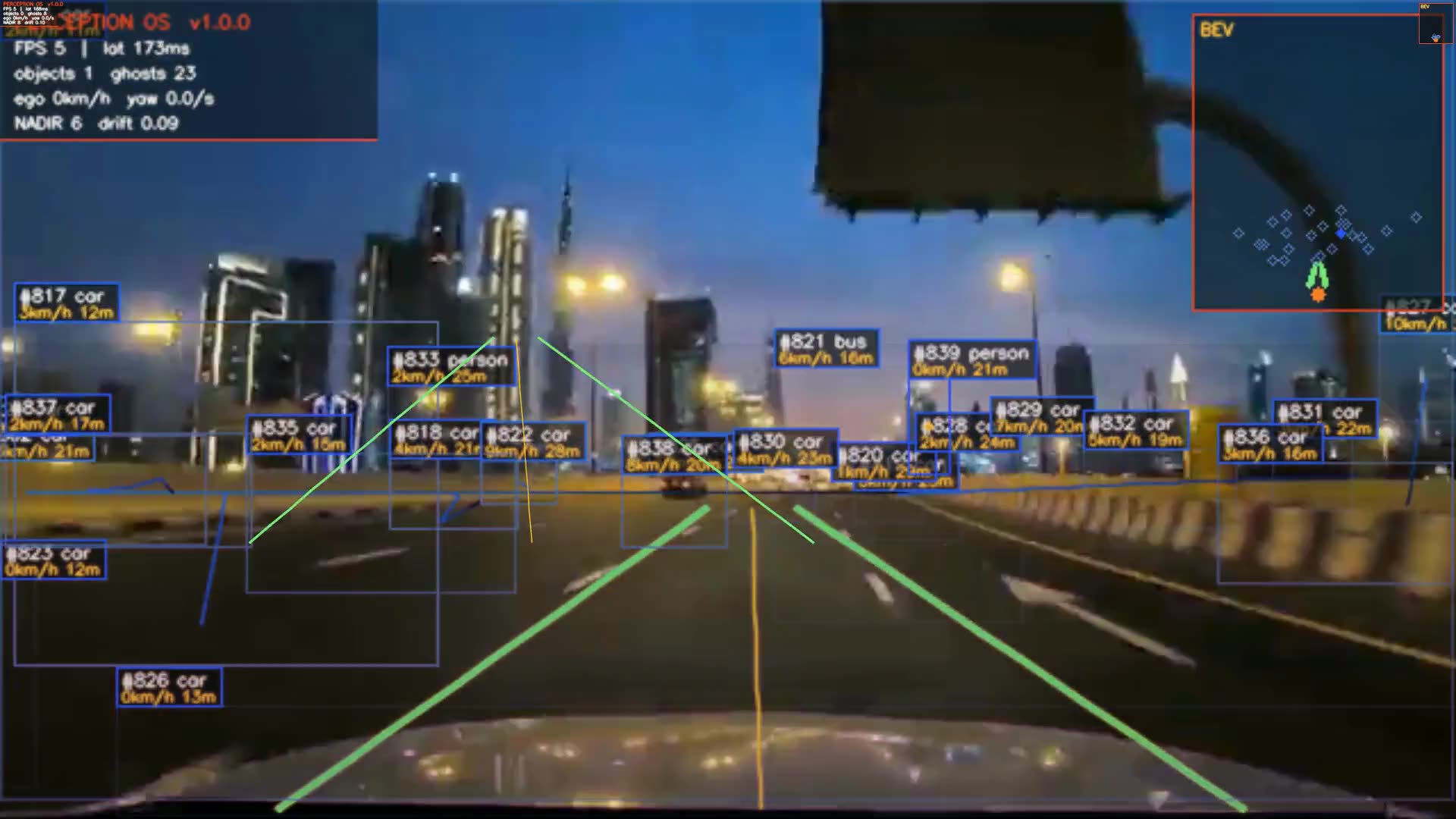
Pre-Seed Stage • Founded 2025

Real-Time ADAS Sensor
Drift Detection Platform

Addressing the $8.4B+ ADAS calibration market with real-time drift detection, automated validation, and fleet intelligence - reducing OEM production costs, collision repair liability, and insurance claim severity.

$30B+
Global ADAS Hardware Market
Rapidly expanding sensor ecosystem
$8.4B
Calibration Services Market (2033)
Total addressable market • 12.8% CAGR
80%+
Uncalibrated Post-Repair
Systemic safety & liability gap
$300-1.5K
Per-Vehicle Calibration Cost
Increasing insurance claim severity

The Critical Problem

Multi-billion dollar systemic failure in ADAS calibration and validation

Sensor Misalignment Crisis

Minor collisions, windshield replacements, and routine maintenance frequently misalign ADAS sensors. Sub-degree camera pitch/yaw errors severely degrade AEB reaction distance, lane-keeping accuracy, and object detection precision - creating cascading safety failures.

Technical Impact:
  • • 0.5° camera pitch error → 15-20% AEB range reduction
  • • Cross-sensor fusion failures increase false negatives
  • • Lane departure warnings become unreliable
  • • Adaptive cruise control distance miscalculation

Calibration Compliance Gap

Industry studies indicate >80% of vehicles requiring post-repair ADAS calibration leave collision centers without proper validation. Shops lack real-time drift detection, automated compliance logging, or validation tools - resulting in massive liability exposure and insurance fraud risk.

Market Failure Vectors:
  • • $300-1.5K calibration cost → shop avoidance incentive
  • • No automated drift validation = no accountability
  • • Insurance claims lack sensor health data
  • • Regulatory compliance impossible to verify

Cascading Economic Impact

OEM factories lose 30-60 minutes per vehicle on end-of-line calibration ($40-80 labor cost + throughput constraints). Fleet operators face compounded exposure: downtime, compliance risk, accident liability, insurance premium inflation, and brand safety damage.

Cost Breakdown (Per Vehicle):
  • • OEM production calibration: $40-80 labor
  • • Aftermarket recalibration: $300-1,500
  • • Fleet downtime: $200-500/day lost productivity
  • • Insurance claim severity increase: 8-15%

Elevator Pitch

NADIR provides continuous, real-time ADAS sensor health monitoring and automated calibration validation for OEMs, fleets, and repair channels - surfacing drift before it impacts safety and creating auditable compliance trails for operations and insurance.

NADIR Solution Architecture

Real-time drift detection, automated validation, and continuous sensor health monitoring

System Architecture Overview

Hardware Layer

Automotive-grade sensor suite

Camera Module
  • • Sony STARVIS / OnSemi
  • • Global shutter CMOS
  • • ≥120 dB HDR
  • • <1ms rolling shutter
  • • ±0.1px distortion calibration
IMU Sensor
  • • Bosch BMI270 6-axis
  • • 16-bit resolution
  • • ±2000°/s gyro range
  • • ±16g accelerometer
  • • 25µs sample jitter
Environmental
  • • Temperature sensor
  • • ±0.5°C accuracy
  • • Strain gauge (optional)
  • • IP67 sealed housing
  • • Conformal coating
Connectivity
  • • GMSL2 (6 Gbps)
  • • CAN FD / FlexRay
  • • Automotive Ethernet
  • • GPS L1/L5 + RTK
  • • LTE-M/5G OTA

Compute Platform

Automotive SoC with safety-critical OS

SoC Options
  • • NVIDIA Orin (254 TOPS)
  • • Qualcomm Snapdragon Ride
  • • TI TDA4VM (8 TOPS)
  • • Hardware watchdog timer
  • • Secure boot (TPM 2.0)
Operating System
  • • Linux 5.15+ (PREEMPT_RT)
  • • QNX 7.1 RTOS option
  • • Safety-certified scheduler
  • • AUTOSAR Adaptive R21-11
  • • HSM cryptographic ops
Performance
  • • <10-15ms latency
  • • 30-60 FPS processing
  • • Multi-sensor fusion
  • • Real-time optimization
  • • ISO 26262 ASIL-D ready

Software Stack

Multi-layer perception & optimization pipeline

Middleware
  • • ROS2 Humble/Iron
  • • IPC orchestration
  • • Data pipelines
  • • Message passing
Core Engine
  • • C++17/20
  • • -O3 optimization
  • • SIMD (AVX2/NEON)
  • • Multi-threading
Acceleration
  • • CUDA 12.x
  • • TensorRT 8.x
  • • <5ms inference
  • • GPU pipelines
Vision & Math
  • • OpenCV 4.8+
  • • Eigen 3.4+
  • • Dense/sparse ops
  • • SIMD linear algebra
Optimization
  • • GTSAM 4.2+
  • • Ceres Solver 2.1+
  • • Factor graphs
  • • Bundle adjustment

Real-Time Processing Pipeline

End-to-end latency <15ms per frame

Core Algorithms

Multi-modal sensor fusion & drift estimation

Drift Estimation
  • • SE(3) transform modeling
  • • Baseline deviation tracking
  • • Nonlinear optimization
  • • ±0.05° angular precision
  • • ±2mm translation accuracy
Sensor Fusion
  • • Camera-radar alignment
  • • IMU motion compensation
  • • EKF/UKF state estimation
  • • Reprojection minimization
  • • Outlier rejection (Huber)
Optimization
  • • Sliding-window BA
  • • Factor graph structure
  • • iSAM2 incremental solver
  • • Levenberg-Marquardt
  • • Schur complement
Validation
  • • Mahalanobis distance
  • • χ² distribution testing
  • • 99.7% confidence (3σ)
  • • Covariance estimation
  • • Alert threshold logic

Real-Time Drift Detection

Continuous SE(3) extrinsic estimation via sliding-window bundle adjustment with <15ms latency. Multi-sensor fusion (camera, radar, IMU) achieves ±0.05° angular precision and ±2mm translation accuracy.

Automated Compliance Validation

ISO 26262 ASIL-D compliant logging with encrypted audit trails. Automated post-repair certification via UDS diagnostics integration. Regulatory compliance documentation for NHTSA/IIHS/Euro NCAP requirements.

Fleet Intelligence Dashboard

Cloud-based fleet management platform with real-time sensor health monitoring across thousands of vehicles. Predictive maintenance scheduling, anomaly detection via ML clustering, downtime reduction analytics, insurance integration APIs.

OEM Production Integration

End-of-line calibration acceleration: reduce 30-60 min manual process to <5 min automated validation. AUTOSAR integration for seamless OEM deployment. Saves $40-80 labor cost + improves throughput by 8-12 vehicles/day per line.

Software Drift Correction

Dynamic extrinsic parameter updates for downstream perception modules. Compensates for thermal drift, vibration-induced shifts, mounting stress. Maintains AEB/LKA performance without physical recalibration - reducing service interventions by 60-70%.

Insurance API Integration

Real-time sensor health data feeds for usage-based insurance (UBI) programs. Automated claims severity assessment based on pre-collision calibration status. Fraud detection via sensor drift timeline correlation with accident reports.

Market Data & Analytics

Comprehensive market analysis with growth projections and financial modeling

Total Addressable Market (TAM)

TAM: ADAS Hardware Market (2024) $30B+
SAM: Calibration Services (2033) $8.4B
SAM: Calibration Tools (2035) $5.0B
SOM: Target Addressable (Y5) $2.2B

Market Growth Trajectory

Calibration Services CAGR 12.8%
Calibration Tools CAGR 13.1%
CaaS CAGR 3.4%

Customer Segment Distribution

Adoption Timeline Forecast

5-Year Financial Projections (Conservative)

2025 (Y1)
$0.8M
Pilot deployments
2026 (Y2)
$4.2M
Early OEM + fleets
2027 (Y3)
$18.5M
Scale production
2028 (Y4)
$52.3M
Market expansion
2029 (Y5)
$124.7M
Multiple OEMs

OEM Production

$2.1B

End-of-line calibration automation

• 90M+ vehicles/year globally
• $40-80 labor cost savings/unit
• Throughput optimization

Collision Repair

$3.5B

Post-repair recalibration validation

• 40M+ collision repairs/year (US)
• $300-1,500 calibration cost
• Liability risk mitigation

Fleet Management

$1.8B

Continuous monitoring & compliance

• 6M+ commercial fleet vehicles (US)
• Downtime reduction
• Insurance premium savings

Insurance/Warranty

$1.0B

UBI programs & fraud detection

• Sensor health data monetization
• Claims severity reduction
• Fraud prevention analytics

Platform Capabilities

Enterprise-grade features for OEM, aftermarket, and fleet deployments

Tier-1 Suppliers

Bosch, Valeo, Continental, Aptiv, Magna

Gap: Static factory calibration only - no continuous monitoring
Gap: No aftermarket drift detection solutions

OEM Tech Groups

GM, Ford, Toyota, VW internal R&D

Gap: Proprietary systems - no cross-OEM platform
Gap: Focus on AV, not calibration validation

ADAS Software

Mobileye, NVIDIA, Waymo

Gap: Perception algorithms - not calibration tools
Gap: No aftermarket service integration

Fleet Telematics

Verizon Connect, Samsara, Geotab

Gap: GPS/OBD tracking - no sensor-level diagnostics
Gap: No ADAS calibration expertise

Repair Tech

Mitchell, CCC Intelligent Solutions

Gap: Estimating software - no calibration validation
Gap: Manual process workflows

NADIR Unique Value Proposition

Only platform offering real-time drift detection + automated validation + fleet intelligence

✓ Real-Time Monitoring

Continuous SE(3) extrinsic tracking vs. static one-time calibration - catches drift before safety degradation

✓ Cross-OEM Platform

AUTOSAR-compatible, OEM-agnostic solution - scales across entire automotive ecosystem vs. proprietary systems

✓ Vertical Integration

Factory → aftermarket → fleet → insurance pipeline - captures value across entire calibration lifecycle

Business Model & Unit Economics

Multi-revenue stream SaaS + hardware model with strong margin profile

Revenue Streams

OEM Hardware + License

$45-75

Per-vehicle hardware module + perpetual software license

• Target: 5-10% OEM penetration by Y5
• 90M vehicles/year → 4.5-9M units/year potential
• Gross margin: 40-50% (hardware + software)

Aftermarket Retrofit

$199-349

Retrofit kit + installation + 1-year service subscription

• TAM: 280M ADAS-equipped vehicles (2024 US installed base)
• Focus: collision repair shops, glass replacement chains
• Gross margin: 55-65% (direct-to-shop channel)

Fleet SaaS Subscription

$8-15/mo

Per-vehicle cloud platform access + API integrations

• TAM: 6M+ commercial fleet vehicles (US)
• LTV: $960-1,800 (10-year vehicle lifetime)
• Gross margin: 80-85% (software-only recurring revenue)

Data Licensing / Insurance API

$2-5/mo

Anonymized sensor health data for UBI programs + analytics

• TAM: 200M+ insured ADAS vehicles (US+EU)
• Partnerships: State Farm, Allstate, Progressive, Geico
• Gross margin: 90-95% (pure data monetization)

Unit Economics (Fleet Customer)

Customer Acquisition Cost (CAC) $480
• Channel-led sales and pilots reduce upfront SDR expenses
• Onboarding automation and integration templates lower cost
• Assumes 50-vehicle fleet average and channel referral economics
Annual Revenue Per Vehicle (ARPV) $220
• Base subscription plus premium analytics and OEM connectors - blended ARPV shown
• Upsells (advanced analytics, API access): +40% potential
Gross Margin 82%
• Cloud infrastructure: $1.50/vehicle/mo
• Support: $4.50/vehicle/mo (amortized)
• Total COGS: $26/vehicle/year
Customer Lifetime (Avg.) 8 years
• Commercial fleet vehicle lifecycle
• Churn rate: ~10% annually with strong retention from API lock-in
Lifetime Value (LTV) $886
Assumed ARPV $220 × 82% margin × 8 years = $1,444 LTV (illustrative)
LTV : CAC Ratio 3.0:1
With channel distribution and reduced SDR cost, LTV:CAC targets 3:1 by Y2-Y3; scale increases LTV via upsells and OEM integrations across Y1-Y5.
Small scale LTV progression: Y1 $1.0k, Y2 $2.8k, Y3 $9.6k, Y4 $28.0k, Y5 $66.0k (per-aggregate-account estimate reflecting fleet unit scale and upsell motion).

5-Year Financial Projections (Conservative)

2025 (Y1)
$0.8M
Pilot deployments
2026 (Y2)
$4.2M
Early OEM + fleets
2027 (Y3)
$18.5M
Scale production
2028 (Y4)
$52.3M
Market expansion
2029 (Y5)
$124.7M
Multiple OEMs

Go-to-Market Strategy

Phased market entry: Fleet → Aftermarket → OEM

1

Phase 1: Fleet Operators (Y1-Y2)

Beachhead market: commercial fleets with high ADAS adoption (delivery, rideshare, trucking). Direct B2B sales targeting 50-500 vehicle fleets. Economics: immediate ROI via downtime reduction, insurance savings, compliance automation.

Target Customers
Amazon Logistics, UPS, FedEx, Uber/Lyft fleet partners, Sysco, Schneider National
Value Proposition
$200-500/vehicle/year savings (downtime + insurance), automated compliance reporting, accident liability reduction
Success Metrics
10K vehicles deployed, 3-5 anchor customers, <6 month payback period validation
2

Phase 2: Aftermarket Collision Repair (Y2-Y3)

Channel partnerships with collision repair networks (Gerber, ABRA, Caliber), glass replacement chains (Safelite), dealer service networks. Retrofit kit + subscription model. Regulatory/insurance pull-through: compliance documentation drives adoption.

Distribution Channels
MSO collision chains (30% of market), dealership service depts, glass/windshield specialists, independent shops
Revenue Model
$199-349 retrofit kit + $6-10/mo subscription per bay, revenue share with insurance DRP programs
Success Metrics
500+ shop locations, 80%+ calibration compliance rate vs. current <20%, insurance partnerships signed
3

Phase 3: OEM Production Integration (Y3-Y5)

Tier-1 partnerships (Bosch, Continental, Aptiv) for OEM program integration. AUTOSAR-compatible solution deployed at end-of-line. Value: $40-80/vehicle labor savings + throughput optimization (8-12 additional vehicles/day per line). Target: 1-2 OEM programs by Y5.

OEM Partnerships
Tier-1 integration (Bosch/Continental as channel), GM/Ford/Stellantis NA programs, VW/Toyota overseas expansion
Technical Integration
AUTOSAR Adaptive compliance, ISO 26262 ASIL-D certification, OEM diagnostic protocol integration (UDS/ODX)
Success Metrics
1-2 OEM production programs, 200K+ vehicles/year with factory-installed NADIR, $45-75 ASP hardware + license

Founding Team

Deep technical expertise in autonomous systems, computer vision, and automotive engineering

DH

Dhruv Hegde

University of Michigan — Computer Science & Mathematics · Co-Founder & CEO

Technical leadership in autonomous vehicle perception systems and ADAS calibration algorithms. Expertise in real-time sensor fusion, computer vision optimization, and automotive safety systems. Previously led perception engineering teams developing production-grade SLAM and localization pipelines. Deep knowledge of ISO 26262 functional safety, AUTOSAR architecture, and OEM integration requirements.

SB

Srivatsan Balaji

University of Michigan — Computer Engineering · Co-Founder & CTO

Specialized in embedded systems architecture, real-time optimization, and automotive-grade software engineering. Deep expertise in nonlinear optimization (GTSAM/Ceres), sensor fusion algorithms (EKF/UKF), and GPU-accelerated computer vision pipelines (CUDA/TensorRT). Background in robotics state estimation, SLAM implementations, and safety-critical software development for automotive Tier-1 suppliers. Strong foundation in automotive networking protocols (CAN/FlexRay/Ethernet) and AUTOSAR integration.

Key Hiring Priorities (Next 12 Months)

Founding Perception Engineer
Embedded perception, SLAM, and optimization experience for production systems
Full-stack Founding Engineer
Cloud and backend systems, React/TypeScript dashboard, API design for fleet integrations

Current Traction & Milestones

Pre-seed stage: MVP development and pilot validation

✓ COMPLETED - Q4 2024

MVP Algorithm Development

Core drift detection algorithms validated on benchmark datasets (KITTI, nuScenes). SE(3) estimation accuracy ±0.05° / ±2mm achieved in simulation.

✓ COMPLETED - Q1 2025

Hardware Prototype Built

Alpha hardware prototype: NVIDIA Orin + Sony STARVIS camera + Bosch IMU. Real-world drift injection testing completed on test vehicle platform.

→ IN PROGRESS - Q1 2025

Pilot Customer Signed (Fleet)

LOI with regional delivery fleet (250 vehicles) for 6-month pilot deployment. Target: validate $400/vehicle/year cost savings thesis.

PLANNED - Q2 2025

Pre-Seed Fundraise Close

Target: $3-5M pre-seed round. Use of funds: team expansion (4-6 engineers), beta hardware production (500 units), pilot deployments (3-5 fleets).

PLANNED - Q3-Q4 2025

Aftermarket Channel Pilots

Beta deployments in 10-15 collision repair shops. Validate calibration compliance improvement (target: <20% → 85%+). Generate insurance partnership case studies.

PLANNED - Q4 2025 / Q1 2026

Seed Round + OEM Engagement

Seed fundraise ($8-15M) based on validated fleet/aftermarket traction. Initiate Tier-1 technical discussions (Bosch, Continental) for OEM program roadmap.

Pre-Seed Funding Round

Raising $200K-400K at a $4M-6M pre-money valuation to fund beta production and pilot deployments

$200K-400K
Target Raise
Supports beta production and 3-5 pilot deployments
$4-6M
Pre-Money Valuation
Reasonable for pre-revenue hardware+SaaS specialized startups
~5-10%
Indicative Dilution
Depends on exact raise; $200K on $4M pre-money ≈ 4.8% post-money, $400K on $4M ≈ 9.1% post-money

Use of Funds Breakdown

Team Expansion 40%
  • • VP Engineering + 2-3 perception engineers
  • • Head of Sales (fleet/aftermarket focus)
  • • Product Manager (OEM integration roadmap)
  • • Support/DevOps engineer
Hardware & Manufacturing 30%
  • • Beta hardware production (500 units)
  • • Automotive-grade component sourcing
  • • ISO 26262 testing/certification prep
  • • Manufacturing partner contracts
Pilot Deployments 20%
  • • 3-5 fleet pilot programs (2K-5K vehicles)
  • • 10-15 collision repair shop installations
  • • Field support + integration engineering
  • • Case study development + ROI validation
Infrastructure & Operations 10%
  • • Cloud infrastructure (AWS/Azure)
  • • Dev tools, CI/CD, testing frameworks
  • • Legal, IP, incorporation costs
  • • Office space + operations overhead

Key Milestones (18-Month Roadmap)

Months 1-6
Team hire, beta hardware production, first fleet pilot launch (500 vehicles)
Months 7-12
Scale to 3-5 fleet pilots (3K vehicles), aftermarket shop deployments (15 locations), revenue validation ($500K-1M ARR)
Months 13-18
Seed fundraise prep ($8-15M), Tier-1 technical engagements, ISO 26262 certification initiation, $2-3M ARR target

Risk Factors & Mitigation

Transparent disclosure of key risks and strategic mitigations

OEM Sales Cycle Length

Risk: OEM procurement cycles 18-36 months; revenue delay risk.

Mitigation:

  • • Prioritize fleet + aftermarket for near-term revenue ($500K-3M ARR by Y2)
  • • Tier-1 partnerships (Bosch/Continental) as OEM channel vs. direct sales
  • • Parallel path: production + aftermarket = diversified revenue mix

Tier-1 / OEM Competition

Risk: Bosch/Continental develop in-house drift detection; vertical integration threat.

Mitigation:

  • • First-mover advantage: aggressive IP development (patents pending)
  • • Cross-OEM platform = Tier-1s prefer neutral 3rd party vs. internal solutions
  • • Aftermarket stronghold defensible (Tier-1s weak in collision repair channel)

ISO 26262 Certification Complexity

Risk: ASIL-D certification 12-18 months + $1-2M cost; delays OEM adoption.

Mitigation:

  • • Phase 1 (fleet/aftermarket): ASIL-B compliance sufficient → faster GTM
  • • Partner with certification consultants (TÜV SÜD, SGS) for parallel development
  • • Budget allocated in Seed round ($500K-1M for certification track)

Customer Acquisition Economics

Risk: Fleet CAC higher than projected; LTV:CAC <3:1 in early years.

Mitigation:

  • • Pilot programs generate case studies → marketing leverage reduces CAC
  • • Channel partnerships (fleet management platforms) for distribution scale
  • • Insurance co-marketing (NADIR validation = premium discounts for fleets)

Let's Build the Future of ADAS Safety

Join us in transforming the $8.4B ADAS calibration market. Seeking strategic partners, investors, and early customers who share our vision for continuous sensor health monitoring.

Contact: dhruv@nadir.ai | srivatsan@nadir.ai

NADIR Technologies Inc. • San Francisco, CA • Founded 2025